I've run product strategy processes for healthcare startups, defense software factories, and enterprise platform teams. The process works. But I'd never turned it on myself.
In April 2026, I built a 16-step product strategy recipe from skills I use with consulting clients: JTBD analysis, persona development, market sizing, north star metric definition, OKR workshops, opportunity-solution trees, RICE scoring, roadmapping, pre-mortems, and a coherence audit. Each step is a reusable skill in my AI agent system, chained together so the output of one feeds the next.
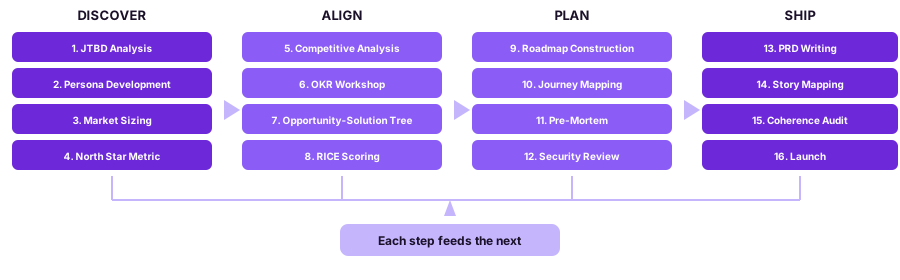
Then I ran the whole thing on k8mak.com. The site I thought I was building wasn't the site I needed.
The setup
k8mak.com launched in early 2026 as a product tools site. Free tools for PMs, a portfolio, and eventually paid products. The strategy was straightforward: build tools, attract practitioners, convert some to paying customers.
I had six jobs-to-be-done mapped, eight personas defined, and a north star metric tracking tool-to-purchase conversions. It all made sense on paper.
Then I left my job.
What the recipe found
Running the full recipe in May, with the context of actually being independent and job searching, changed everything.
A new persona appeared. Step 1 surfaced a persona I'd missed entirely: Hannah, the hiring decision-maker. She visits candidate sites during evaluation. She isn't looking for tools. She is looking for evidence that this person can think clearly about product problems. The site had nothing for her.
The north star metric was blind. My original metric, tool-to-purchase conversions, would score a month where the site landed me a $150K role as a failure because no one bought anything. Step 4 replaced it with Monthly Qualified Engagements, a composite that counts portfolio deep-reads, contact form submissions, and purchases equally. One metric, two value streams.
The market sizing told a brutal truth. Step 2 showed that one successful hire through the site is worth more than 10 years of product revenue at the prices I was planning. Stream B (the site as a professional surface) dwarfs Stream A (the site as a product business) in expected value. I'd been optimizing for the smaller number.
RICE scoring flipped my priorities. Step 8 ranked 30+ features. Portfolio narrative polish ranked #1, not the paid product. Seven of the top twelve priorities were about making the site credible to hiring managers, not about building products for practitioners. The Consulting Starter Pack I'd been focused on dropped from the top priority to rank #9.
The pre-mortem identified the real risk. Step 11 found that the biggest threat wasn't market fit. It was bandwidth. At 8-12 hours per week for site work (with job searching consuming the rest), the roadmap barely fits. Blog posts are the first casualty if anything slips. And one risk stood out: the assumption that hiring managers actually visit candidate sites is genuinely unvalidated.
What actually changed
The recipe produced a four-sprint, 90-day roadmap. But the real output was a strategic pivot I'd not have made without the process forcing it.
Before the recipe, Sprint 1 was "build a purchase flow." After, Sprint 1 became "rewrite five portfolio entries so a hiring manager can assess my work in under two minutes." The purchase flow moved to Sprint 3.
I rewrote the portfolio entries to an outcome-first structure: bold impact line, narrative middle, forward-looking close. I added proof points to interior pages. I wrote a "Why breadth matters" section explaining why working across healthcare, defense, and enterprise is a pattern recognition engine, not a lack of focus.
These changes took days, not weeks. They were cheap and directly tied to the highest-value outcome (a role or consulting engagement worth orders of magnitude more than product sales).
The coherence check
Step 15 ran a full coherence audit. Every feature traces to an OKR. Every OKR traces to the north star metric. Every opportunity maps to a JTBD and a persona. Zero orphans.
The dual-stream model holds. But it holds because the recipe forced me to acknowledge that Stream B is primary, not because both streams are equal. That's the kind of insight you miss when you skip the process and go straight to building.
Why this matters beyond my site
The recipe is 16 skills chained together. Each one is a standalone tool I use with clients. The chain is what makes it powerful: JTBD findings constrain persona development, personas constrain opportunity mapping, opportunities constrain RICE scoring, RICE constrains the roadmap. Every step narrows the space of reasonable next moves.
Most product teams skip steps. They jump from "we've an idea" to "let's build it." The recipe makes skipping expensive because each step depends on the one before it.
I built these skills to help other product leaders. Running them on my own site was the best validation I could have done. Not because the recipe is perfect, but because it caught a strategic blind spot that would have cost me months of building the wrong thing.
The site is still early. The first paid product isn't live yet. But the foundation is pointed at the right problem now, and I have a clear decision framework for what to build next. That's what a product strategy process is supposed to do.
Related services
Frameworks for this topic
Read next
A coworker pool needed a bracket app and the draft was twelve hours away. I built the core that evening, everyone picked the next morning, and then I spent a week turning a pick form into a live match companion. Here is what shipping under a real deadline for a small trusted group actually teaches you.
An EU AI Act readiness assessment inventories every AI system you build or use, classifies each against the Act's risk tiers, and lists the gaps. The high-risk deadline moved to December 2027, but prohibitions, AI literacy, GPAI and transparency rules already apply today.
BBFantasy is a fantasy draft league for Big Brother, live for the season 28 premiere. I ran the same 16-step product process I run for clients on my own reality-TV habit, and the analytics rerouted the entire strategy.
Want to work together?
I help teams ship better products. Let's talk about your situation.
Get in touch