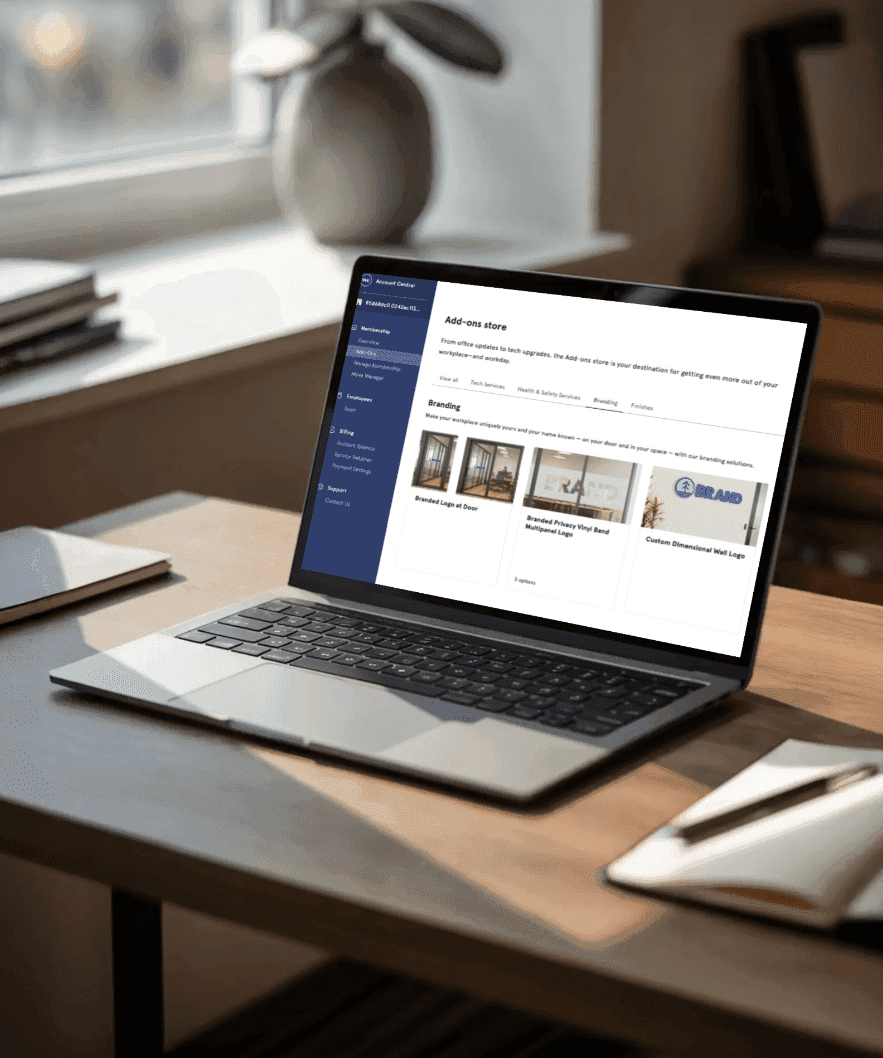
Member Add-Ons Platform for WeWork Locations
Retail & Marketplace0-to-1 MVPGrowth & Engagement
Kate brought structure to ambiguity. She helped us clarify the strategy, align global teams, and prototype fast, all while keeping the user at the center.
The impact
Consistent global add-on offerings enabled for the first time. Net-new revenue unlocked with minimal development overhead. Community Manager time on manual fulfillment tasks significantly reduced. Foundation set for WeWork's broader Member Services roadmap.
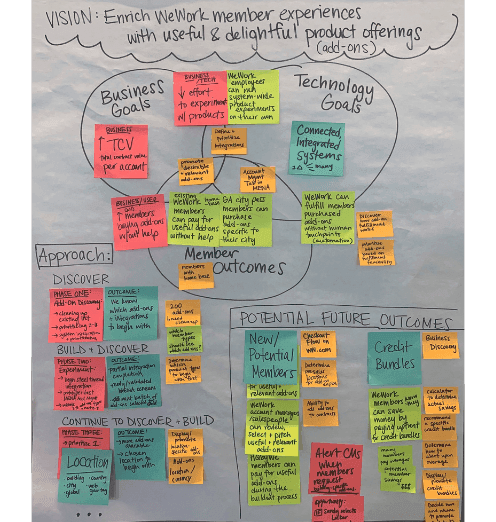
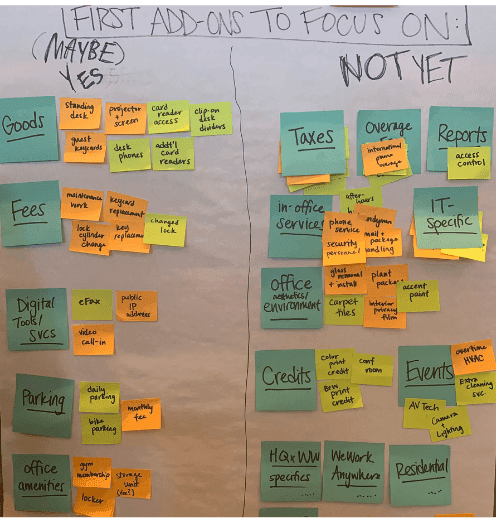
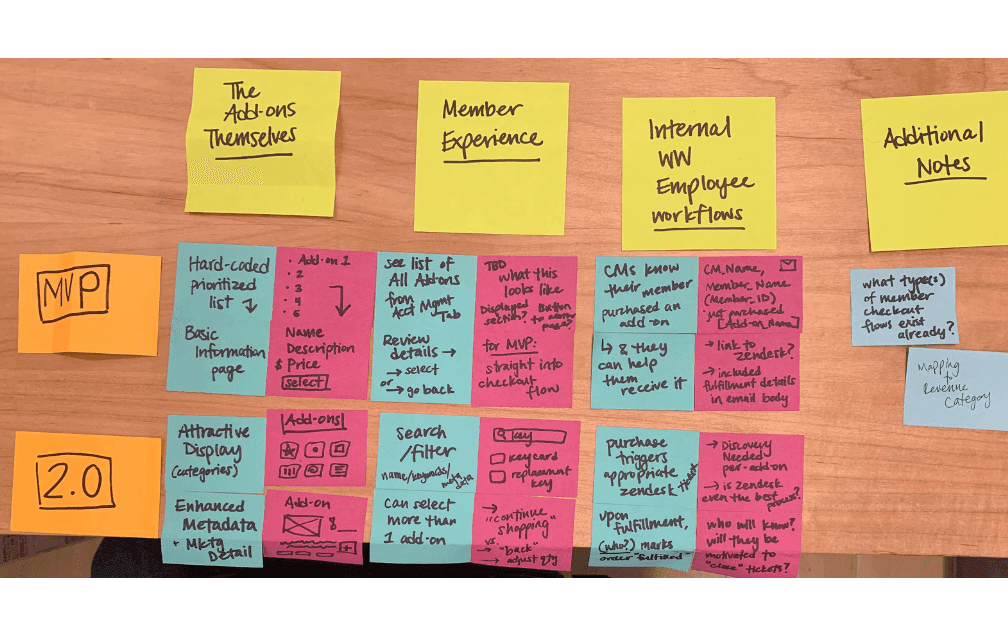
I built and shipped WeWork's first internal platform for offering, tracking, and fulfilling member add-ons, from mail services to furniture rentals to event bookings. The 0-to-1 MVP replaced a patchwork of spreadsheets and Slack threads with a single interface that worked for members and Community Managers across global locations.
The hard part was the variation, not the catalog
Every WeWork location had its own informal version of "extra." Members wanted coffee upgrades, storage, conference rooms, and printing. Community Managers fulfilled these ad hoc, through whatever mix of spreadsheets, DMs, and verbal agreements had evolved at each site. No shared pricing, no inventory visibility, no way to know a request was fulfilled until something went wrong.
A generalist would have built a catalog and called it done. The real problem was structural: add-ons spanned genuinely different domains, digital services, physical logistics, and billing, and what counted as an "add-on" in one market did not match another. Build one rigid system and every region breaks it; build one system per region and you have rebuilt the chaos with better tooling. So the design question was not "what's in the catalog," it was "what architecture absorbs regional variation without fragmenting."
Modularity was the leverage
I modeled fulfillment paths with decision trees and journey mapping to find the patterns underneath the local improvisation, then scoped a modular architecture where region-specific services were configuration, not new code. I validated UX across 4 pilot locations with rapid prototypes and built admin tools for pricing, approval, and inventory. The payoff is the part that compounds: a new add-on type, or a new market, became a configuration change rather than an engineering project, which is what turned a one-off MVP into the foundation for Member Services at large.
What this built
- A first-ever unified add-on platform. Members and Community Managers across global locations could finally interact through the same system, with consistent pricing and fulfillment logic.
- A net-new revenue channel with low development cost. The modular architecture meant new add-on types could be added without rebuilding the platform.
- The foundation for WeWork's broader Member Services roadmap. The roadmap, patterns, and admin tooling from this engagement set the direction for WeWork's broader member services strategy.
The thinking behind this work
Iteration Planning
Iteration planning is where commitment meets reality. Done well, it gives the team a shared plan they believe in. Done poorly, it's a status meeting with extra steps.
Story Writing
A well-written story is a contract between product and engineering. It says what 'done' means before anyone writes a line of code.
Pairing
Pairing isn't pair programming. It's any two people solving a problem together in real time - PM and designer on discovery, engineer and AI on implementation, product and engineering on technical scoping.
Services behind this work
Related case studies
Compass: Distributor Sales Enablement Portal for Sealed Air
Product Manager & Inception Coach · 2017
Led a full Pivotal Labs inception for Compass, a sales-enablement portal that made distributor reps sound like packaging experts in the moment, built around one field insight: make me an expert, fast.
Agile Estimation Platform Redesign for PlanningPoker.com
Development Team Coordinator · 2015
Redesigned PlanningPoker to improve agile team workflows and estimation clarity.
Private Car Negotiation Flow for AutoTrader's MakeMyDeal
Agile Delivery Lead · 2014-2015
Built new flow for private car buyers to negotiate with sellers inside AutoTrader's platform.
Want to bring this kind of thinking to your team?
I help teams ship products with clarity, speed, and care.
Or trace the through-line: the full 14-year career timeline →