People stall on creative work because they try to do everything at once. They want the first draft to be the final draft. They edit while they brainstorm. They polish sentences before they know what the piece is about.
I've watched this happen with blog posts, product specs, pitch decks, workshop agendas, and investor narratives. The symptom is always the same: someone staring at a blank page, convinced the next word needs to be perfect. It doesn't. It needs to exist.
The pitch deck is the sharpest example, the place where the story matters most and gets polished last. If that's the work in front of you, here's what a pitch deck has to do.
Every piece of creative work moves through four phases. Not because I invented a framework, but because I noticed the pattern after years of coaching people through the stuck.
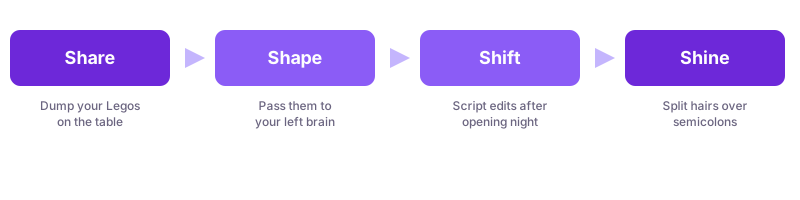
Share
To share is to explore what your idea might be. I describe it as dumping all of your Legos on the table.
Sharing is unfiltered, unedited, unprocessed. It looks and feels sloppy, circuitous, redundant, emotional. This is the rough draft. The voice memo recorded while walking the dog. The overcaffeinated conversation with a thought partner where you repeat yourself three times and contradict yourself twice. The term "word vomit" comes to mind, and it's accurate.
Most people skip this phase or try to make it presentable. That's the mistake. Sharing isn't for the audience. It's for you. You can't shape what you haven't dumped out yet.
Shape
To shape is to create a logical sequence or container. I describe it as passing your idea to your left brain.
Shaping is strategic, clinical, practical. It feels abstract and unemotional. You're building an outline, designing a flow, creating parameters. You're asking: what's the throughline? What does this piece need to do? What can I cut?
The Legos are on the table. Now you're sorting by color.
Shift
To shift is to collect the audience's experience of your idea, draw insights, and make decisions with those insights. I describe it as the script edits after opening night.
Here's the playwright version. You're sitting in the theater during previews. An actor delivers a joke you wrote. Nobody laughs. You have two choices: insist the joke is funny, or change the joke. Shifting means changing the joke.
This phase is painful. It's frustrating. It affirms the worries you didn't want to speak aloud. But it's also where mediocre work becomes good work. The spec that confused stakeholders gets restructured. The presentation that lost the room at slide four gets resequenced. The blog post that buried the lead gets a new opening.
Shine
To shine is to spend time managing the superficial details such that they complement your idea. I describe it as splitting hairs over semicolons.
This is voice, tone, word choice, formatting, pace. It's the phase most people jump to first and wonder why their work feels hollow. Shine without share is decoration. Shine after shift is craft.
The real framework
These four phases aren't a waterfall. You'll loop back. You'll share again after shifting. You'll reshape after shining reveals a structural problem. But the sequence matters as a default, because the most common creative failure is polishing something you haven't tested, built on a structure you haven't examined, from raw material you never fully dumped out.
Get it all out. Organize it. Test it. Then, and only then, make it beautiful.
If your team is stuck producing work that looks polished but doesn't land, let's talk.
Related services
Frameworks for this topic
Read next
Most teams argue about research as a binary: do it or skip it. Both extremes lose. Months of upfront research goes stale before build starts, and no research turns designers into pixel machines. I spent four years at Pivotal coaching the narrow middle: just enough research, at the right moments, to go fast forever.
We know consent has to be freely given, reversible, informed, enthusiastic, and specific when it's about our bodies. Our data is a body too. Here's what happens when you run your product's data handling through the same five tests, and why a cross-tenant leak is a consent failure, not just a security bug.
Most teams aren't balanced. One discipline decides and the others execute. I spent four years at Pivotal coaching the alternative, and the difference between the two isn't org charts. It's who has voice, who has a vote, and whether the team can celebrate a failed experiment without flinching.
Want to work together?
I help teams ship better products. Let's talk about your situation.
Get in touch