A founder reached out about Wingmates, a community product for men. We met for lunch on the Google campus where he works as an engineer. He had the vision, the energy, and the ability to build whatever he wanted. That was exactly the trap. When you can build anything, the obvious next move is to start building: pick the stack, open the app, ship features, and wait for the community to arrive.
The hard part of an early community product is not the platform. It is proving the audience wants it. The product can fail not because the software is bad but because nobody knows what these members actually care about, which topics earn a reply, or which formats make someone come back. Building first spends real effort on an unvalidated bet.
A good first consult does one thing: it reframes the question from "what should we build" to "what can we learn this week for almost nothing." Then it leaves the founder with a roadmap of cheap experiments they can start immediately. Here is how to run it.
1. Reframe build into learn
Spend the first part of the conversation naming the riskiest assumption in one sentence. For an audience-dependent product it is almost always the same: this audience wants this, will show up, and will engage. Everything after that is a cheap test of that one sentence. The founder usually arrives wanting to talk about features. Move them, gently, to talking about evidence.
2. Map the field before you map the product
Do a fast competitive scan of what the audience already uses. For Wingmates that meant existing men's communities and resources: ManKind Project, EVRYMAN, Men's Tribes, MenLiving, HeadsUpGuys, and relevant subreddits. For each, capture one line: what format it uses, what topics draw people in, and what you could borrow or do differently. This keeps the founder from reinventing what already works and teaches you the audience's own language.
3. Sequence the experiments that need no engineering
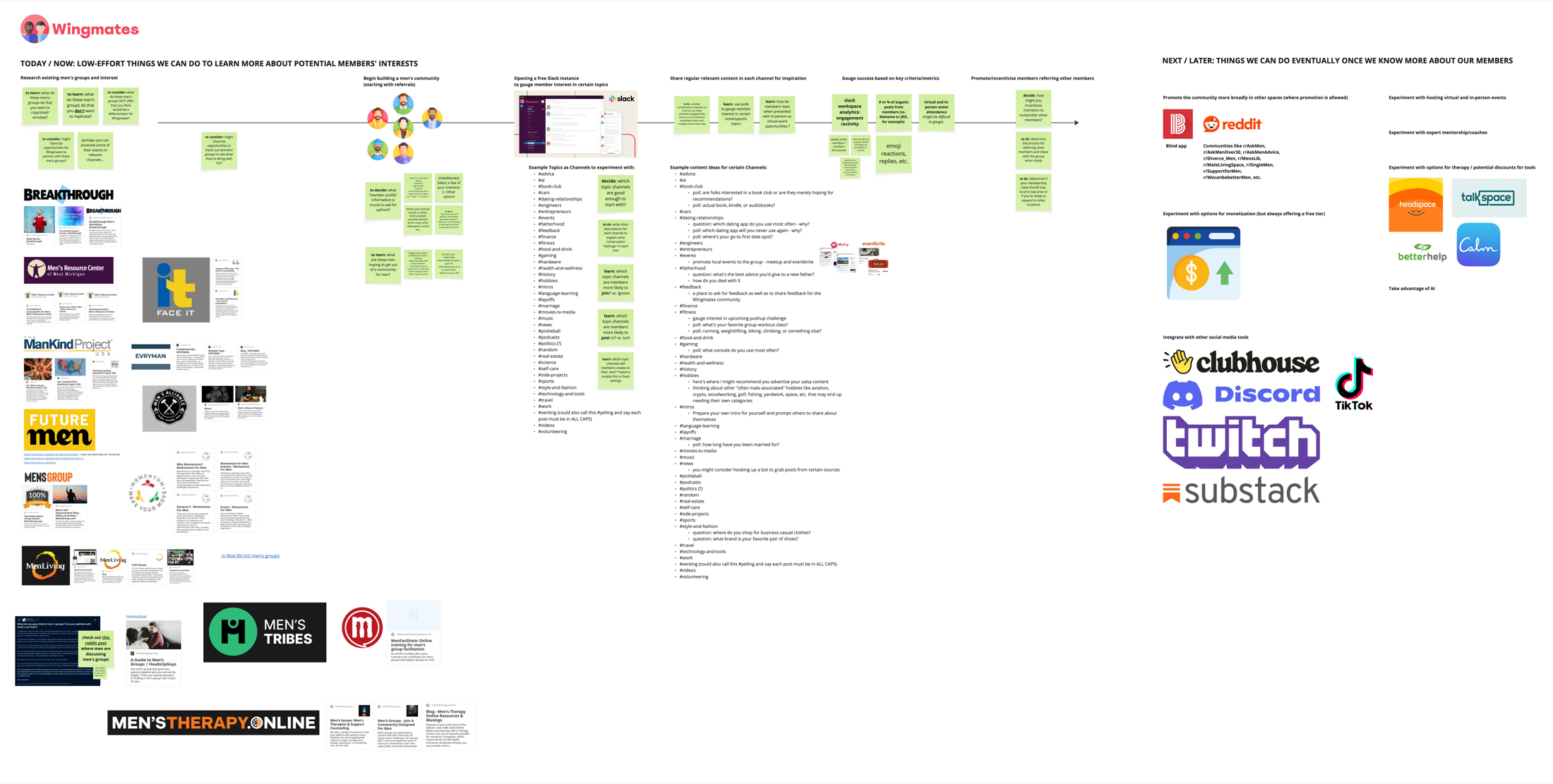
Lay out a left-to-right sequence of moves the founder can run this week without building anything:
- Research existing groups and interest
- Seed a small community through referrals
- Open a free Slack or Discord instance to gauge which topics members care about
- Share content per channel to see what earns a reaction
- Gauge success on a few key signals
- Incentivize members to refer others
Attach a "to learn" note to each step. An experiment with no learning attached is just a task.
4. Make "gauge interest" concrete
"See what people want" is not actionable. Turn it into a list of things to post. Propose candidate channels (fatherhood, fitness, dating, layoffs, finance, mental health, and more) and for the promising ones write a specific poll or prompt to test. Now the founder has homework, not a vague intention.
5. Decide what success looks like early
Name the few leading signals that say an experiment worked: engagement and activity, the share of organic posts coming from members rather than the founder, event attendance, and reactions. Favor signals that show up early. Avoid vanity totals.
6. Hold the bigger bets for later
Everything that costs real effort goes in a Next / Later column, each gated by a learning condition: broader promotion, virtual and in-person events, expert mentorship, tool integrations, and monetization. If monetization appears, always keep a free tier. The gate matters more than the list. Nothing here starts until the founder has learned the thing that justifies it.
The deliverable
The output of the hour is a single board: a "Now / Next-Later" low-effort discovery roadmap the founder can act on that week.
Where this sits in the founder's bigger sequence
A founder eventually works through nine questions: what will you build, how will you build it, what will you charge, who will you hire, do culture and values matter, how will you find your first customers, how should you think about competitors, what will you measure, and how will you grow. This consult deliberately zooms in on three of them - what will you build, how will you find your first customers, and what will you measure - because those are the ones you can de-risk this week for almost nothing. The rest come into focus once the audience bet is validated. Point the founder at the full arc when they're ready to widen the lens.
Why a free consult is worth it
A focused hour plus an hour of your own research produces a deliverable that genuinely helps a founder and shows exactly how you think. It is the cheapest possible proof of value, and it converts naturally into a paid engagement when the founder is ready to go deeper. The lesson generalizes well past men's communities: when a founder can build anything, the scarce resource is not capability, it is evidence. Validate the audience before you build the platform, and let the cheapest possible signal decide what gets made.
To produce the board itself, run the /discovery-roadmap skill.
Sources
- The nine-question founder sequence is the spine of Intercom on Starting Up (Intercom, 2017). Referenced here; the full arc is covered in the founder guidance on the blog.
Skills for this topic
AI skills you can run with Claude or Codex to put this practice to work.
/discovery-roadmapDiscovery RoadmapBuild a Now / Next-Later board of low-effort experiments to validate an early product or community before building it.
/discovery-questionsDiscovery QuestionsGenerate discovery questions tailored to a prospect.
/now-next-later-roadmapNow/Next/Later RoadmapBuild a stakeholder-ready roadmap divided into Now/Next/Later, optionally generate a branded deck and share via Slack, Miro, FigJam, or Notion.
See this in practice
Real engagements where this practice did the work.
A free one-hour founder consult turned into a low-effort discovery roadmap: cheap experiments that validate a community product's audience before any platform gets built.
Fractional Head of Product for FLUXX, a clinician-led menopause platform. Took it from clinical research with no product infrastructure to a launched MVP in under six months, with AI phase scoring validated by real clinicians and a re-engagement model that beat healthtech norms.
Served as Fractional Director of Product to lead Sperity Health from vaporware to a functioning, HIPAA-compliant MVP. Built the roadmap, treatment logic, product team, and app experience for members to understand diagnostics, track progress, and access elite care.
Related practices
Want help with the free founder consult?
I coach teams on this practice. Let's talk about your situation.
Get in touch