I've built three digital health products that turn clinical data into coaching. Each one taught me the same thing: measuring isn't the hard part. Meaning is.
The Bluetooth Problem
At Kaiser Permanente, we shipped Health Ally for members managing chronic conditions. Thousands of people had connected devices sitting in drawers, still in the box. They weren't ignoring their health. They couldn't pair their devices.
We built a Bluetooth pairing guide. Simple, visual, step-by-step. Adoption climbed. Showing people how to connect their data turned out to be just as impactful as what the data said.
That pairing guide wasn't a "nice to have." It was the product.
Badges Beat Dashboards
Health Ally also had a tips and nudges system. It delivered value even when members hadn't logged new data in days. No guilt trips. No "you haven't checked in" notifications. Just useful coaching that met people where they were.
Then we added badges. Engagement jumped 27%, from 619K to 788K monthly sessions. Our diabetes tips hit a 9.2:1 like-to-dislike ratio. Members weren't just opening the app. They were telling us the content landed.
Badges worked because they named progress. Not "you're doing great!" but "you completed seven days of tracking." Specificity builds trust.
Display, Explain, Advise, Encourage
At Sperity Health, we turned lab results into plain-language coaching across nine biomarkers. The design research was clear: people wanted meaning, not medical jargon.
We landed on a four-step framework.
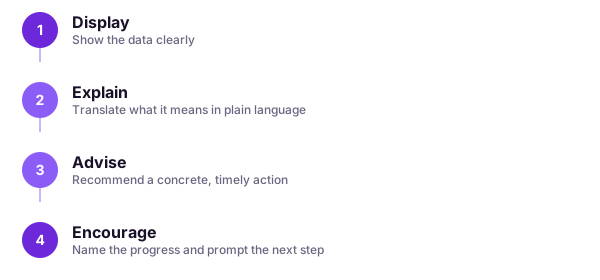
Display the data. Explain what it means. Advise on what to do. Encourage the next step.
If glucose was rising, we didn't say "exercise more." We suggested movement within the next few hours. Concrete, timely, actionable. That's the difference between a dashboard and a coach.
Personas That Respect the Journey
FLUXX Health builds menopause education, a space where most products either infantilize or ignore. We created two persona layers: phase-based (where someone is biologically) and decision-based (how they approach treatment choices).
Decided Debbie wants clear options. Suspicious Susan needs evidence before she'll engage. Natural Nancy won't consider pharmaceuticals. Empowered Elaine is already managing her own protocol. Same condition, four completely different product experiences.
A quiz-based phase detection system routes people to the right content without asking them to self-diagnose. The product adapts to the person, not the other way around.
The Shared DNA
Three products. Three conditions. One pattern.
Measure what matters most. Translate data into meaning. Coach with empathy.
Health products that stop at the dashboard are tools. Health products that coach through the data are companions. The gap between those two is where behavior change lives.
If you're building a health product that needs to move from metrics to motivation, let's talk. For the broader healthcare product landscape, see building products in healthcare.
Related work
Related services
Frameworks for this topic
Read next
Founders come to me with what feels like one urgent question. Underneath it is almost always the next question in a sequence every founder walks: what to build, how, what to charge, who to hire, and eventually how to grow. Here are the nine, with the coaching lens I bring to each.
A repeatable six-move method for live PM whiteboarding, drawn from five real interviews and client sessions. The point is not the answer. It is letting people watch you think.
A was a sharp engineer and artist who didn't want to commit to working on anything. The most useful thing I did as her mentor wasn't teaching her design, it was a tough-love conversation about being organized and accountable for deliverables. Here's the story of the accountability turn, sanded off for no one.
Want to work together?
I help teams ship better products. Let's talk about your situation.
Get in touch