Megan is one of my wife Zoe's oldest friends. They played soccer together in college. So when Megan mentioned she was thinking about a career pivot, this wasn't a stranger sliding into my DMs. It was someone I'd known for years, sitting at the same kitchen table.
She'd just had her first baby and was getting ready to go back to work. She didn't want to go back to the same thing. She just wasn't sure what the new thing was. I told her what I always tell people in that spot: let's start with your resume, and we'll figure out the rest from there.
It started with a resume
She sent me what she had. It was a tidy, completely standard account-associate resume from her years in commercial furniture, where she'd run a thousand projects a year on a $35M account. Good work. Generic resume. The kind that hides the person doing the work.
But as we talked through her actual days, something kept jumping out at me. She'd led a process-mapping workshop to untangle how orders moved between teams. She'd spotted the repetitive handoff mistakes that were quietly costing real money, and she'd put a tool in place that cut average project cost by 30%. She talked about her customers like she actually thought about them. She was already doing UX. She was already thinking in systems. She just didn't have the words for it yet.
So I made her an offer. Forget the resume for a second. Let me show you what this field is actually called, and let's find out if you like it.
After the baby was asleep
Here's the part I'm proud of, and it has nothing to do with frameworks. Megan had a newborn. The only reliable window she had was after the baby went down for the night. So that's when we met. Every week, an hour and a half to two hours, after bedtime, for about a year.
I built her a map before I gave her a single task. A deep-dive doc: what UX research actually is, the difference between research and design, the field guides worth reading, real researcher portfolios to study, and where to get paid to be a usability-test participant so she could feel the work from the other side. Zoe and I also set up what we called the Kate and Zoe scholarship, which is a fancy way of saying we covered any course she wanted to take. The point was to strip out every excuse that wasn't about the work itself.
Then I laid out the whole arc so she could see where we were headed: learn the craft, build real proof, fix how she showed up online, then go get the job.
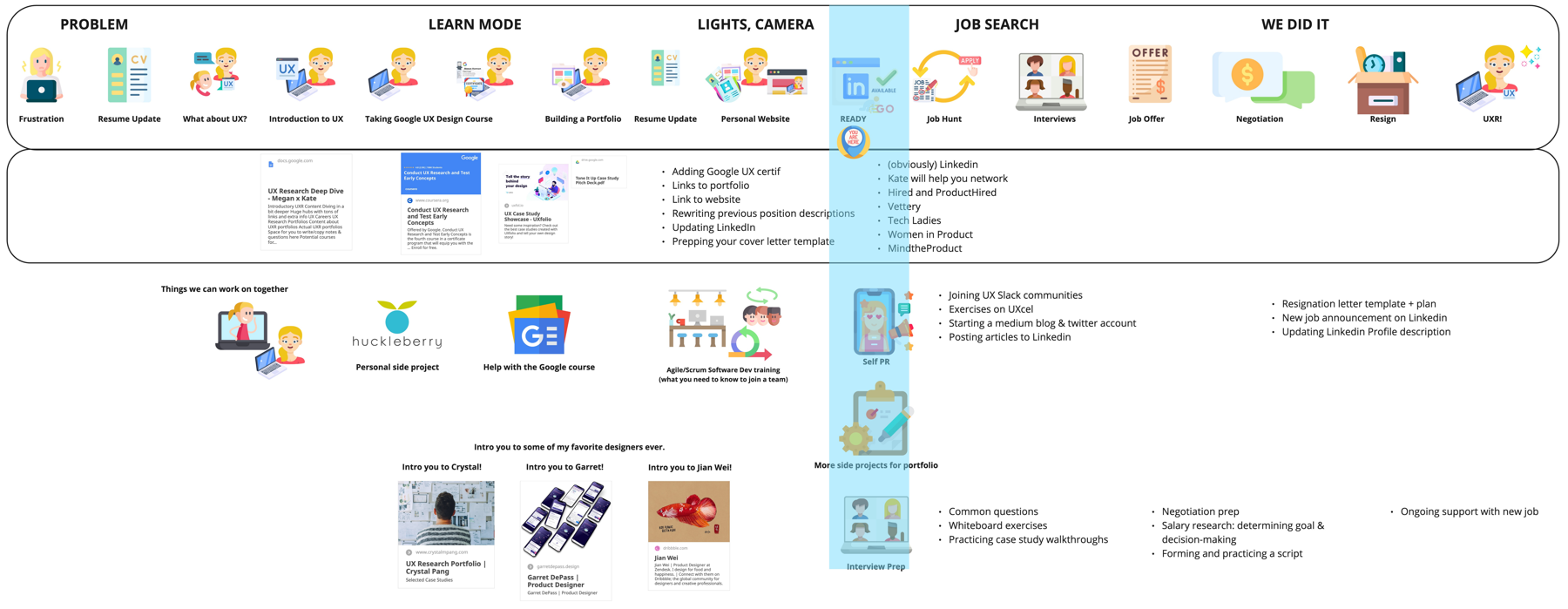
We started with an app she already knew
I didn't want her first UX exercise to be abstract. I wanted it to be something she touched every day. And as a sleep-deprived new mom, the app she touched every day was Huckleberry, the baby sleep-tracking app.
So that's where we started. I gave her a teardown assignment: look at the brand, the language, the navigation, who the customers are, what would make someone try it, and who would never need it. Real terminology, learned on a product she already had feelings about.
Her first pass was thoughtful and also a little off, and that turned out to be the most useful thing that happened all month. She described the site one way. What I was looking at was different. Instead of marking it wrong, we talked about why. Maybe she was logged in and seeing a different state. Maybe they were testing content across sessions. Maybe she was looking at the app and I was looking at the marketing site. That conversation, about why two careful people see two different things, is a real UX research conversation. To keep us in sync, I moved everything into a shared Miro board, and that board became our studio for the rest of the year.
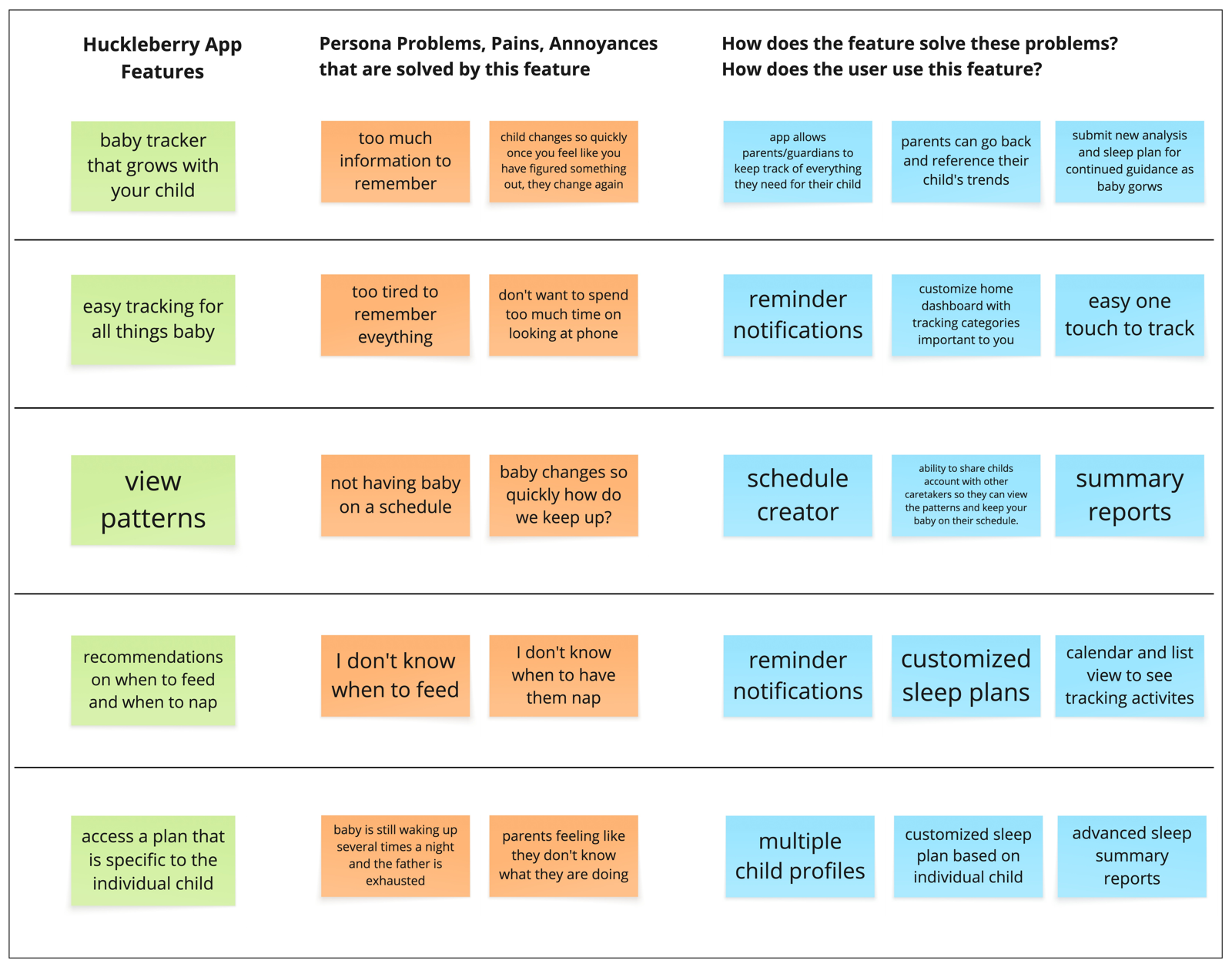
On it, she mapped every Huckleberry feature to the specific parent pain it solved, and how. Look at this and tell me it isn't a researcher's brain at work.
Then she designed her own app
Once she had the vocabulary, she needed a project that was hers. She'd spent a chunk of her twenties in the fitness world, so that's where her idea lived: Motiv8, an app to help personal trainers keep clients motivated and booking. This became the case study she carried all the way through the Google UX Design certificate, November 2022 to June 2023.
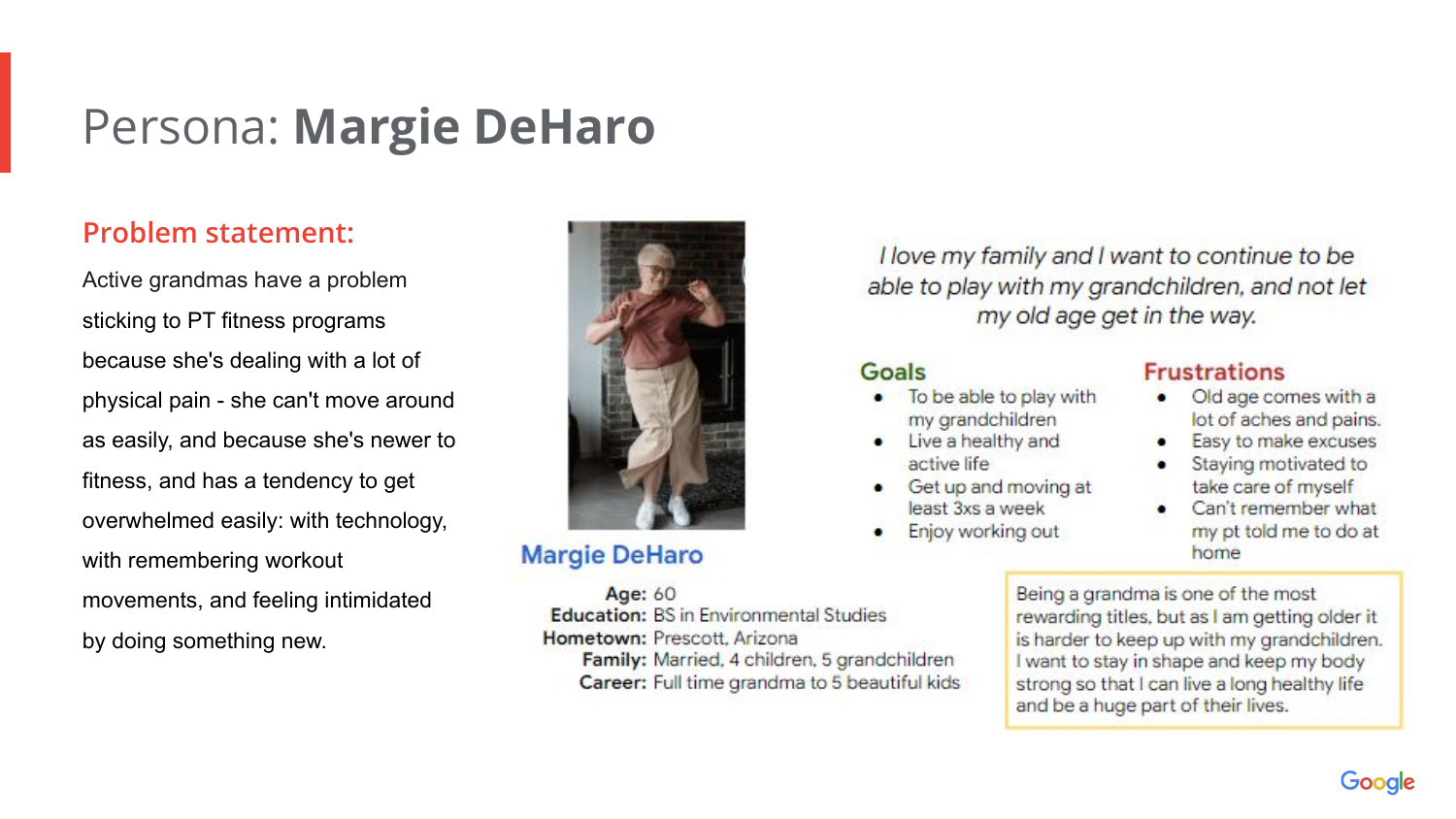
She did the research properly. Interviews, empathy maps, and three personas that were anything but cardboard. Margie, a sixty-year-old grandmother who wanted to stay strong enough to keep up with five grandkids but couldn't remember what her physical therapist told her to do at home. Theodore, a twenty-two-year-old college running back who lost all his motivation the second the season ended. Angie, a personal trainer drowning in the time it took to rebuild programs and losing clients after one session.
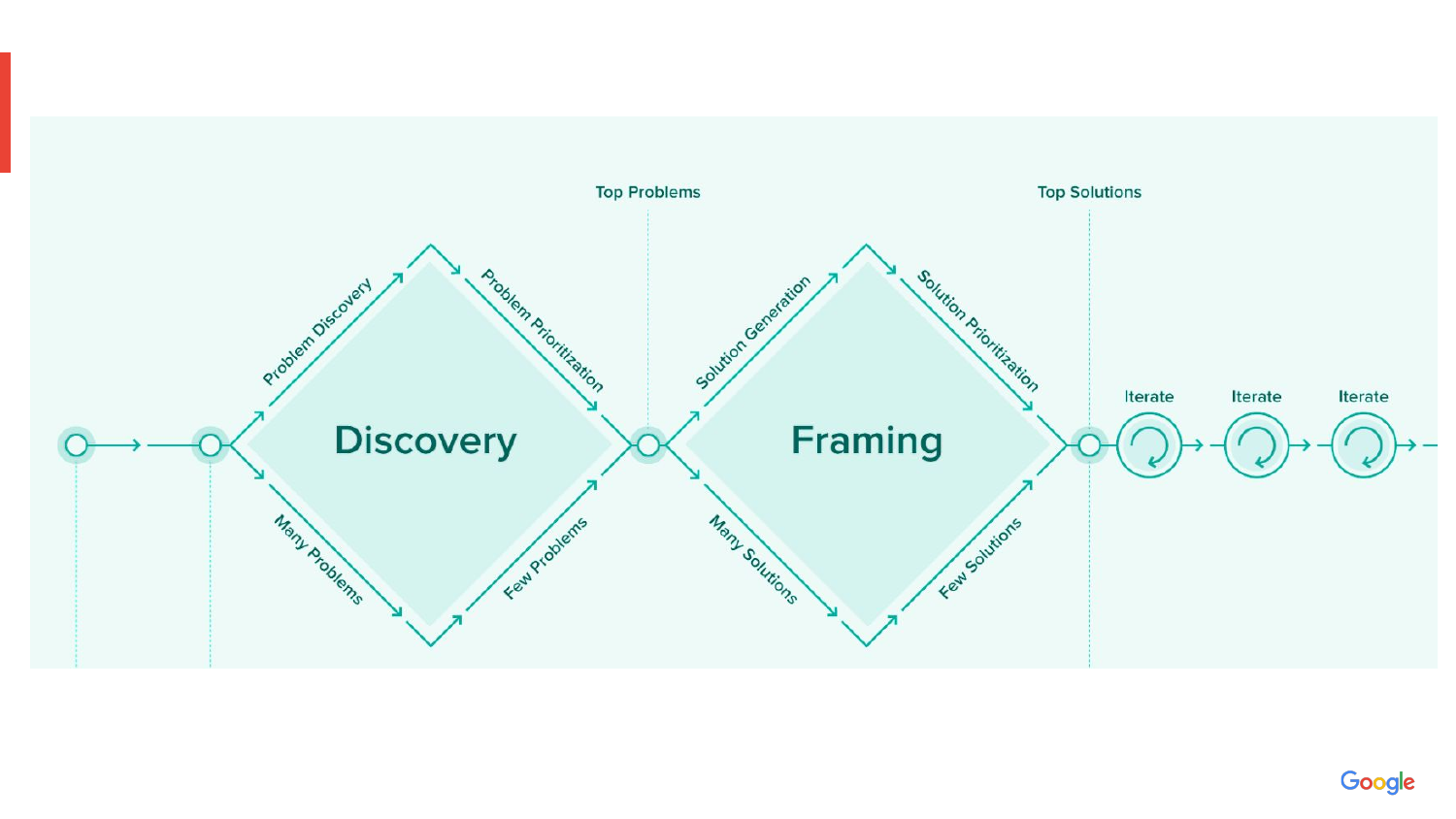
Then she ran the work through Discovery and Framing, the same double-diamond shape I'd taught her: open up to find the real problems, narrow to the ones that matter, open up again to generate solutions, narrow to the ones worth building, then iterate. Watching her use that framework in her own deck, in her own words, was the moment I knew it had stuck.
She mapped Margie's full journey, from "my body's aching" all the way to "I can play with my grandchildren without pain," with the emotions and the opportunity gaps called out at every step.
The part where she killed her own feature
This is the moment that separates someone who's learning the steps from someone who actually gets it.
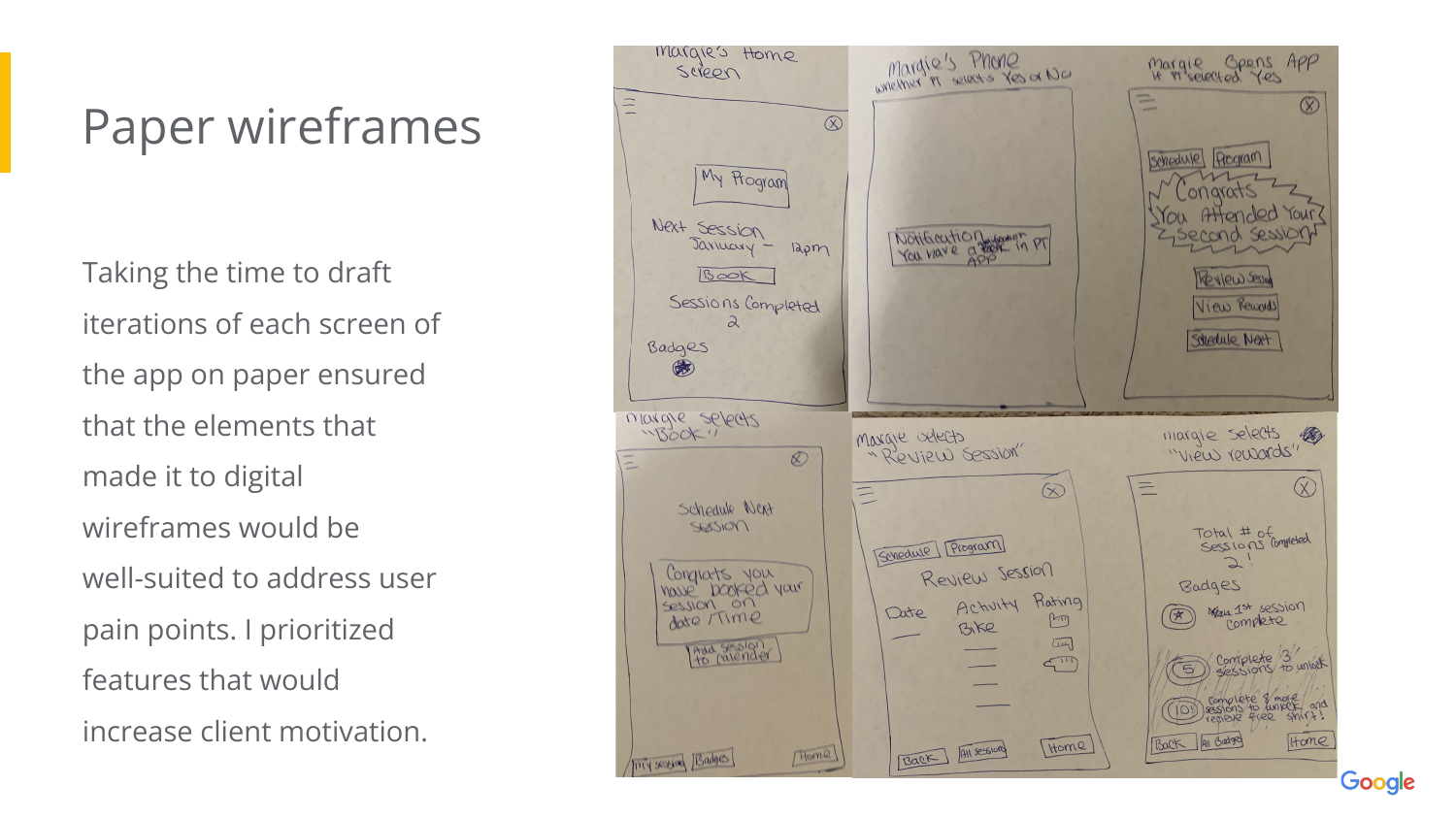
Megan went from paper sketches to digital wireframes to a clickable prototype, and she tested three features she thought would drive motivation: a badges-and-rewards system, a rate-your-workout survey, and in-app booking.
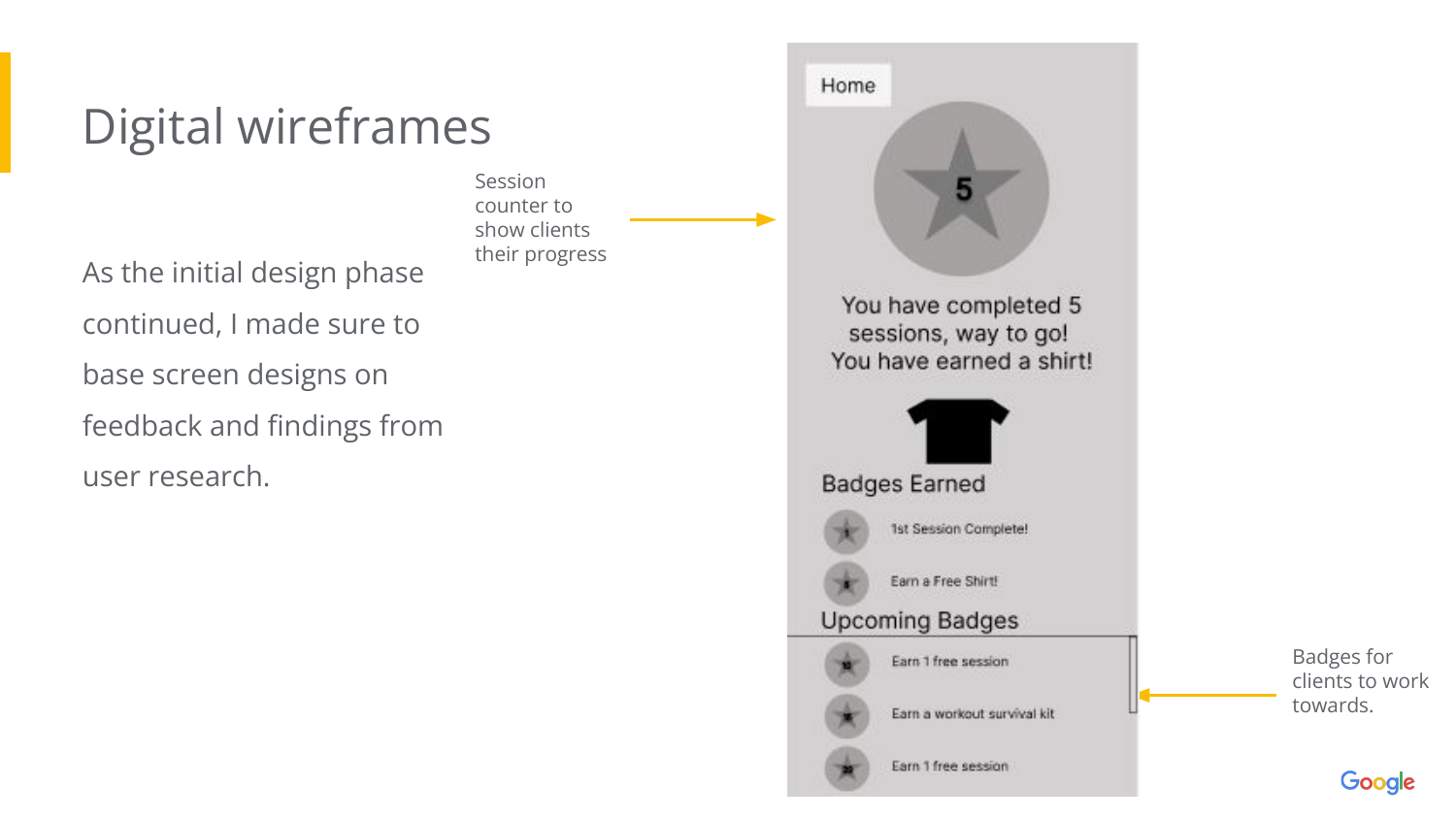
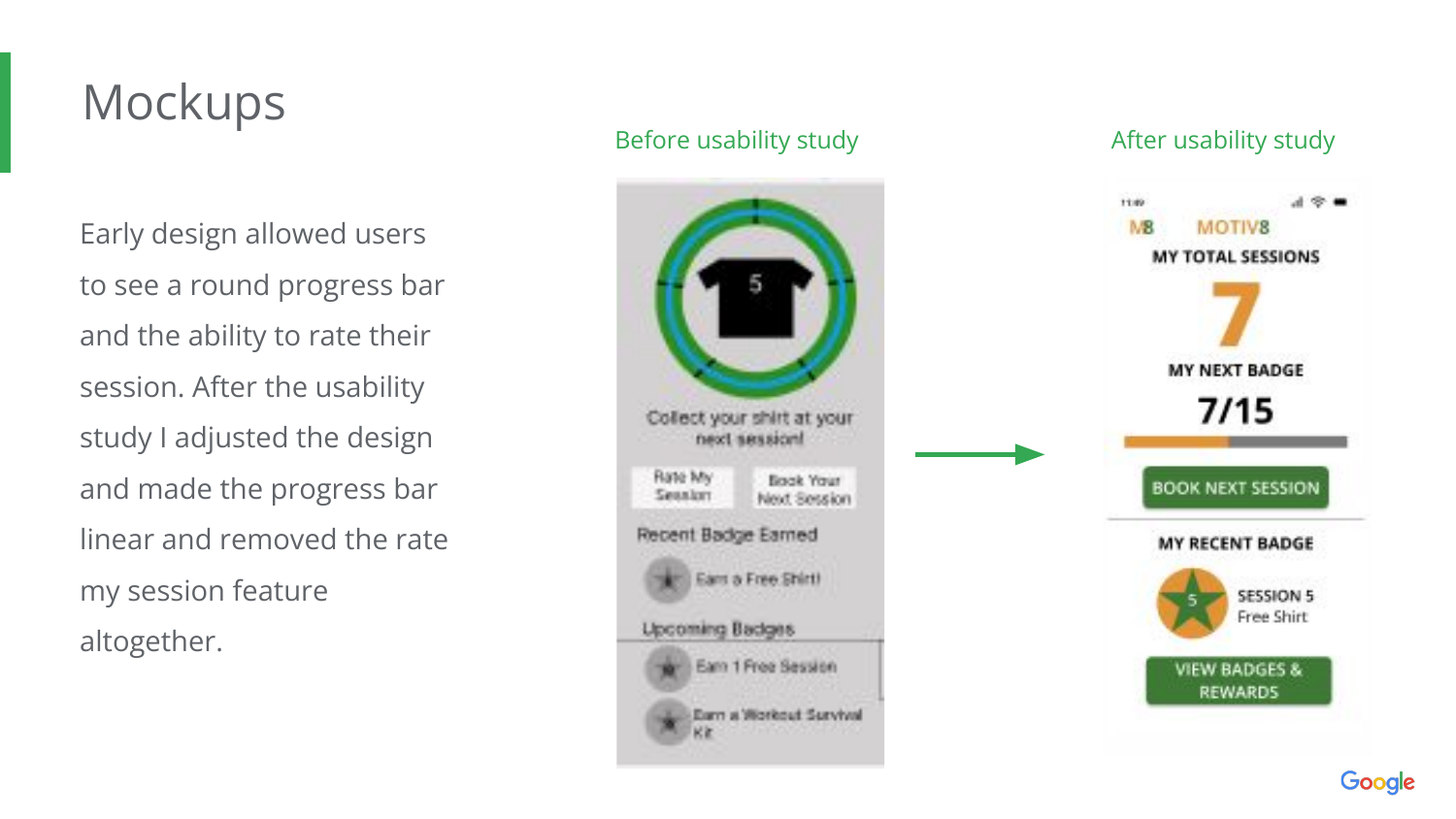
She ran two rounds of usability tests with five training clients and three trainers. And the feedback gutted one of her favorite ideas. Nobody wanted the survey. "I am paying my personal trainer to tell me what to do." "I never take surveys, I just check the boxes without reading them." Meanwhile the badges lit people up: one person told her about a gym program where she earned t-shirts and "was so proud every time I won a shirt."
So she made the call. She cut the rating feature entirely, reworked the round progress bar into a clean linear one, and changed booking from an in-app calendar to a simple message to the trainer, because that's how trainers said they actually wanted to do it. She killed a feature she'd already built, because the evidence told her to.
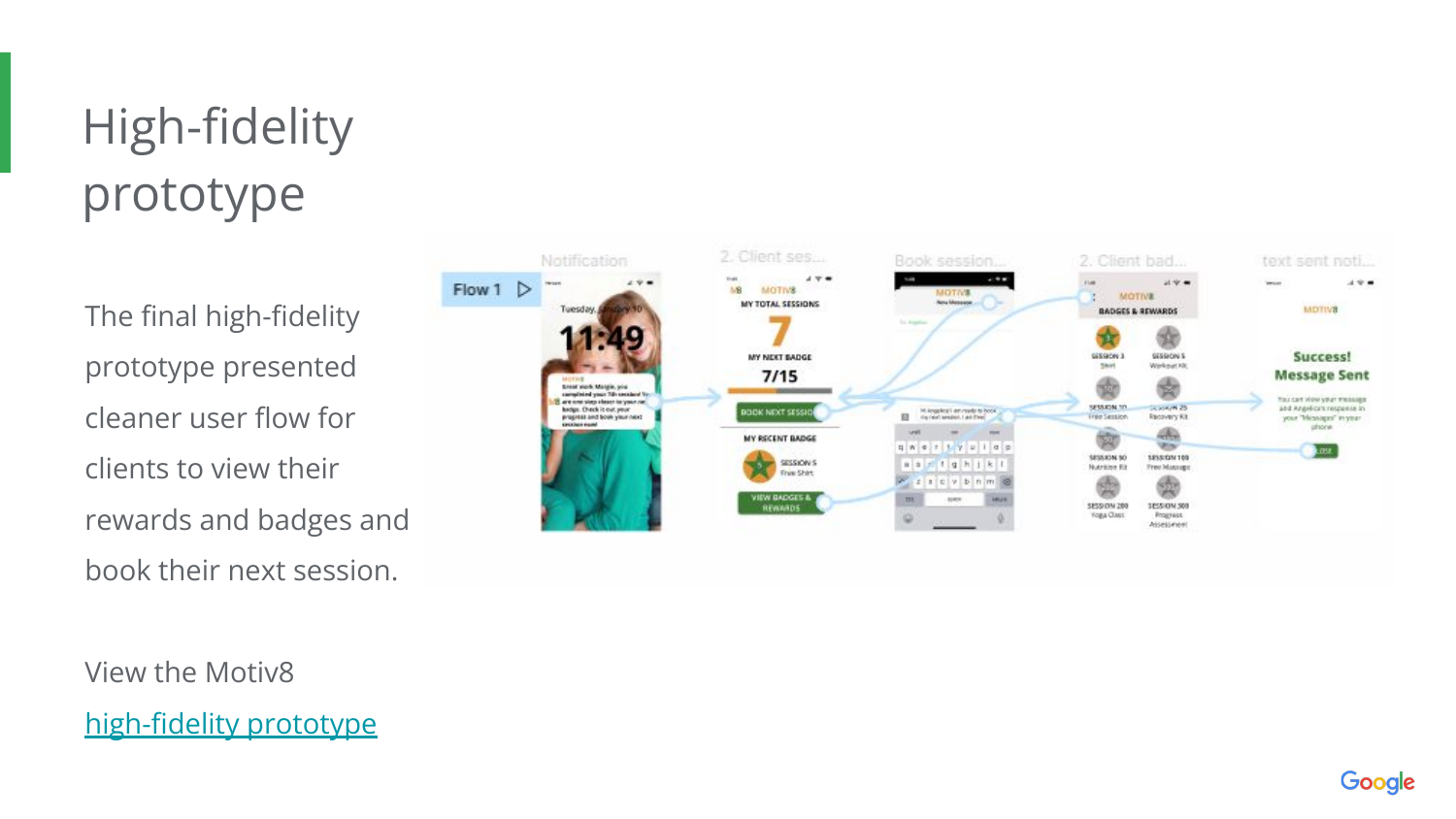
That's the hardest skill to teach, and she got there on her own. The result was a genuine high-fidelity prototype, accessibility considerations and all.
Making it legible
Good work is only half of a career change. The other half is making it findable. We rewrote her resume so it led with UX research and design and reframed her furniture and Salesforce years as the project management and stakeholder skills they always were. We rebuilt her LinkedIn around a real headline. She stood up a portfolio site and wrote her own About page: "I love helping people. I believe you cannot truly help someone unless you understand them and their needs." That one sentence is the entire job, and she found it in her own words.
The honest ending
Here's where Megan's story is different from the ones people tell on stages.
She earned the certificate. She built two real case studies. Her research was solid, her artifacts were strong, and she could talk about her thinking like someone who belonged in the room. And then, right around the time she finished, a different opportunity came to her through a friend, and she took it. Not a UX role. A different path entirely.
I want to be clear that this isn't a disappointing ending. It's an honest one.
Megan got exactly what good mentorship is supposed to give a person: a real look at the work, the skills to do it, and enough self-knowledge to make a clear-eyed choice about whether she wanted it. Some people do a year of UX and sprint toward it. Some people do a year of UX and realize the thing they love, understanding people, lives somewhere else for them. Both of those are wins. The only real failure would've been Megan spending two more years wondering "what if" without ever doing the work to find out.
What I took from it
Coaching someone isn't a funnel with a guaranteed conversion at the bottom. When I coach a career-changer, my job is to make the path real and walkable, build the proof alongside them, and then respect whatever they decide once they can finally see the work clearly. I'm proud of what Megan built. I'm prouder that she made an honest decision with real information instead of a fearful one with none.
If you're standing at the edge of a pivot and you're not sure whether the field you're dreaming about is the one you actually want, that's not a reason to wait. It's a reason to go do one small piece of the real work and find out. I'll help you build it either way.
Related services
Frameworks for this topic
Read next
Fern joined my Out in Tech mentorship with a degree in environmental studies, a hand-built zine, and a grad-school dream in graphic and web design. Over our time together they learned personas, journey maps, prototyping, and usability testing, and carried their creative voice all the way through. Here's how it went.
A was a sharp engineer and artist who didn't want to commit to working on anything. The most useful thing I did as her mentor wasn't teaching her design, it was a tough-love conversation about being organized and accountable for deliverables. Here's the story of the accountability turn, sanded off for no one.
Most PM skills matrices fall flat. I built one based on spheres of influence - self, team, org - because skill is not tenure.
Want to work together?
I help teams ship better products. Let's talk about your situation.
Get in touch